Culture essay Mon, July 27
Five times this summer, the City of Brookings has published a notice to inform residents that members of the City Council might be spotted having a good time. Not at a hearing. Not in Council Chambers. On Main Avenue, at Downtown at Sundown, the weekly summer gathering of food trucks, live music and lawn chairs that has nothing whatsoever to do with municipal government. July 30. August 6. August 13. August 20. August 27. Each notice says essentially the same thing: at least four council members may attend, no city business will be conducted, this is simply a heads-up in case you see a majority of the council enjoying the evening downtown along with everyone else. A sixth notice, for August 21, extends the same courtesy to a gathering at SDSU's Meet State event.
It would be easy to read these as administrative debris, the kind of thing a city clerk generates to keep the lawyers satisfied and that no one actually reads. That would be a mistake. Taken together, the sundown notices are one of the more revealing documents Brookings has produced this year about what it actually means to govern, and be governed, in a town this size.
South Dakota's open-meetings law exists to prevent exactly the kind of thing these notices are announcing: a quorum of elected officials discussing public business outside the public's view. The law doesn't care whether the setting is a boardroom or a beer garden. If four of the nine council members are standing near each other with a hot dog in hand, the law wants a paper trail, just in case. That is sound legal reasoning, and no one should want it weakened. But apply it to a town of roughly 24,000 people, where the mayor buys groceries at the same store as half the electorate and the council members' kids play on the same summer league teams, and something almost comic happens: transparency law starts requiring the city to formally document the ordinary physics of small-town life, which is that everyone keeps running into everyone else.
Compare this to the council's actual business this stretch. On July 30, the same body that needs a quorum notice to attend a street festival held public hearings on leasing city property to RTI, LLC, on annexing two outlots into the city, and on a budget amendment, plus a first reading on rezoning land in the Third Addition from B-4 to B-2. These are the decisions that shape what Brookings looks like in five years, and they happened in a chamber, on the record, broadcast on the Government Channel, exactly as the law intends. The sundown notices are the negative image of that process: proof that the same officials also exist as private citizens who like brisket and cover bands, and that the law, in its caution, cannot quite tell the two modes apart from a distance.
There's a useful way to think about this split, borrowed loosely from the old distinction between the public square and the agora, the place of deliberation and the place of appearance. Hannah Arendt argued that a genuine public life requires citizens to show themselves to one another, not just to vote on things in private. Brookings, almost by accident, has built a civic calendar that stages both halves of that equation on the same street. Main Avenue on a Thursday evening in summer is where the council appears as neighbors; the Government Center three blocks away is where they act as officials. The quorum notice is the seam between the two, made visible only because the law insists on stitching it shut in advance.
There's also something worth noticing about scale. A city the size of Sioux Falls would never need to issue this kind of notice, because a quorum of its council could vanish into a crowd of any size without anyone clocking it. Brookings can't do that. Four council members at a food-truck rally are a statistically significant fraction of the whole. The town is small enough that its officials cannot disappear into anonymity even when they try to, and that, rather than being an inconvenience, is close to the definition of a functioning small democracy. You know who represents you because you might stand next to them in line for a taco.
The sundown notices will keep coming through August, dutifully filed, almost certainly unread by most of the people they're written for. But they are quietly doing something more interesting than covering the city's legal bases. They're recording, week by week, a town too small to let its government and its social life fully separate, and choosing, sensibly, to write that fact down rather than pretend otherwise.

Culture essay Sun, July 26
Between now and the end of August, Brookings City Hall will issue six separate public notices warning that a majority of the City Council might be in the same place at the same time. Five of those notices concern Downtown at Sundown, the Thursday evening concert series on Main Avenue. The sixth concerns Meet State, the annual welcome event for South Dakota State University students. In every case the notice says the same thing: at least four council members may attend, no city business will be conducted, this is not a meeting. It is simply, as the language goes, a heads-up.
Read once, this is bureaucratic housekeeping, the kind of thing that exists because South Dakota's open meetings law defines a quorum by proximity rather than intent. Read six times over six weeks, it starts to look like something else: a town narrating its own transparency so insistently that the notice becomes more visible than the substance it's meant to safeguard.
Consider what else happened on the council's actual agenda during this same stretch. On July 30, the council held a public hearing on leasing city property to a private company, RTI, LLC. It passed the second reading of a budget amendment altering the 2026 city budget. It voted to annex two outlots into city limits, extending Brookings's boundary a little further into the county. It reviewed the 2025 financial audit. These are the decisions that shape what the city taxes, owns, and controls going forward. None of them generated a repeated public notice. None of them recurred weekly across the tenure of a whole summer. They happened once, in the standard Thursday-evening format, filed alongside a proclamation for ADA Day and a first reading on rezoning near Third Addition.
The quorum notices, by contrast, are relentless. Every single Thursday in August, without variation in language, the city reminds residents that council members might be standing near a beer garden. The repetition is not evidence of any particular event's importance. It is evidence of a legal reflex: once a councilmember's attendance at a public gathering becomes routine, the notice must become routine too, regardless of whether anything is actually at stake.
There is a version of this story that is purely comic, a small-town parody of sunshine law where the most heavily documented civic activity of the season is elected officials listening to music. But there's a more serious point underneath it, one that matters for how residents relate to their own government. Open meetings statutes were written to prevent quiet, coordinated decision-making outside the public record, the classic fear being officials working out a deal over coffee before ratifying it later in front of cameras. That fear is legitimate. But the law, applied literally to a city the size of Brookings, cannot distinguish between four council members conspiring in a back room and four council members standing twenty feet apart from each other at a street fair, one buying a bratwurst, another watching a cover band. The statute has no mechanism for scale. It treats a town of thirty-five thousand the way it would treat a much larger municipality where council members genuinely might not otherwise cross paths, where any gathering of four is more likely evidence of intention than coincidence.
In a place like Brookings, the opposite is closer to the truth. Council members turning up downtown on a Thursday night isn't a suspicious convergence, it is what living in a small city looks like. They are there for the same reason everyone else is: because Main Avenue on a summer evening is one of the few places the whole town actually shows up. The notice, technically accurate, misrepresents the nature of the event it's attached to. It frames an ordinary act of civic presence, elected officials being residents among residents, as something requiring legal disclosure.
None of this means the notices should stop. The law is the law, and erring toward disclosure is safer than erring away from it. But it's worth naming what the accumulation of these notices actually communicates to a reader scanning the city's public calendar: that compliance can be performed so thoroughly it becomes its own kind of noise, one that risks drowning out the parts of governance that actually deserve scrutiny. A resident who wants to know what the city intends to do with a leased outlot, or how a fifth budget amendment changes municipal spending, has to sort past a stack of nearly identical notices about a concert series to find it.
Transparency, taken to its logical extreme, doesn't always illuminate. Sometimes it just repeats itself until the outline of what matters gets harder to see. Brookings isn't unique in this, but it is small enough that the pattern shows plainly: the loudest notice on the books this August isn't about a lease or an annexation. It's about the possibility that the council might, like everyone else in town, enjoy a Thursday night out.
Commentary Sat, July 25
There is a particular genre of civic prose that Brookings has, this summer, elevated nearly to art form: the quorum notice that insists, with the gentle firmness of a librarian shushing a toddler, that nothing is happening here. Four City Council members might be at Meet State on August 21. They might be at Downtown at Sundown on July 30, and again August 6, and 13, and 20, and 27, in a kind of civic residency. And each time, the notice arrives like a chaperone at a dance: yes, they'll be in the room, but no, nothing official will occur. No motions. No votes. Just elected officials, standing near each other, enjoying a bratwurst.
One appreciates the diligence. South Dakota's open meetings law is not interested in vibes; it cares about bodies in space, and if four-sevenths of the council happens to cluster near the same funnel cake stand, the state wants a paper trail proving that clustering isn't legislating. Fair enough. Democracy has been undone by cozier things than a shared appetite for sweet corn. But there is something wonderfully absurd about a town so orderly that it must formally announce, in writing, that its leaders are allowed to have a nice evening without accidentally rezoning anything.
Imagine explaining this to a visitor. “Are they meeting?” No. “Are they doing city business?” No. “Will they be in the same three-block radius on Main Avenue, holding lemonade?” Yes, six Thursdays running. It reads like a fugitive being tailed by his own alibi. The council isn't hiding; it's pre-confessing.
And yet the joke, once you sit with it, has a spine. These notices are the small print of self-government, the unglamorous scaffolding that keeps public trust from getting wobbly. It would be easy, elsewhere, for four officials to “run into each other” at a bar and quietly settle next year's budget between rounds. Brookings instead requires that any such gathering be flagged in advance, like a controlled burn. The result is faintly comic, sure, a summer calendar dotted with disclaimers about the absence of business, but comedy here is doing the work of transparency. The notice is boring on purpose. Boring, in municipal governance, is usually a compliment.
Meanwhile, actual business does grind forward, at actual meetings, with actual votes. On July 30 the council will hold hearings on leasing city land to an outfit called RTI, LLC, and on annexing a couple of outlots that sound like a very small nation seeking UN recognition. There will be budget amendments, zoning first readings, an audit report, and a proclamation for ADA Day. This is the unphotogenic marrow of local government, the stuff that never gets a quorum notice because it's the whole point of the meeting rather than an accidental side effect of a summer stroll. Nobody writes a wistful little paragraph about Resolution 26-041. But it's Resolution 26-041, not the funnel cake, that decides who leases what land and where the sidewalk ends.
Out in Lake Hendricks Township, the Planning and Zoning Commission is wrestling with a rather more concentrated drama: one property, four separate requests, including an accessory building larger than the rules allow and a variance filed after the shed, evidently, was already standing. There's a certain folk-tale quality to the after-the-fact variance, the zoning equivalent of asking forgiveness rather than permission, then discovering the county keeps a very detailed ledger of forgiveness requests. Two-thirds of the board must approve the variances; a simple majority will do for the conditional use permit. Somewhere in Lake Hendricks Township, an accessory building is currently living what lawyers call an “unresolved legal status,” which is a fancy way of saying the shed doesn't know yet if it's allowed to exist.
Set the two storylines side by side and Brookings' civic character comes into focus rather nicely. It is a place that will tolerate a shed built first and justified later, but will not tolerate four council members standing near lemonade without a disclaimer. That is not hypocrisy so much as proportion: the shed affects one lot; the council affects everyone. The paperwork scales to the stakes.
So when Thursday rolls around and Main Avenue fills with music and popcorn smell and, yes, probably a majority-adjacent cluster of your elected representatives, go ahead and enjoy it exactly as intended: as a street party, not a session. The notice has already done the worrying for you. That's rather the point of good government, come to think of it. It should be so quietly competent that the most exciting thing on the agenda is the weather, and the biggest scandal in town is a shed that filed its paperwork late.

Science Fri, July 24
On Friday, July 17, the National Weather Service posted a Heat Advisory for Brookings County, warning that the heat index would climb to 100 between 1 and 9 p.m. If you checked a thermometer that afternoon, though, you might not have seen triple digits at all. The actual air temperature that day was likely somewhere in the upper 80s or low 90s. So where did the 100 come from?
That gap between what a thermometer says and what a body feels is the whole point of the heat index, sometimes called the “feels like” temperature. It is not a measurement in the way degrees Fahrenheit is a measurement. It is a calculation, one that tries to capture something thermometers cannot: how humidity interferes with the body's main cooling system.
Here is the mechanism. When it is hot, the body sweats, and as that sweat evaporates off the skin, it carries heat away. This is basic physics, the same principle that cools a glass of water wrapped in a wet towel. Evaporation is what does the work. But evaporation depends on the air's capacity to absorb more moisture. Dry air is thirsty, so sweat evaporates fast and cools efficiently. Humid air is already saturated, so sweat lingers on the skin, doing little. The heat index tries to translate that reduced cooling efficiency back into a temperature number, essentially answering the question: if the air were dry, how hot would it have to be to feel this oppressive?
The formula behind it traces back to work by physicist Robert Steadman in 1979, who modeled a hypothetical person, roughly 5-foot-7, 147 pounds, walking outdoors in the shade, and calculated how various combinations of temperature and humidity would affect that person's perceived heat load. The National Weather Service still uses a regression equation built on Steadman's model today, an approximation refined over decades but still, at its core, an estimate rather than a physical constant like temperature itself.
That is worth sitting with for a second. A heat index of 100 is a modeled judgment, not a direct reading. Two locations at the identical air temperature can carry very different heat index values depending purely on moisture in the air. This is why South Dakota summers can feel deceptively brutal even when the mercury seems unremarkable. A humid air mass moving up from the Gulf, common in mid-July, can push the heat index well above the actual temperature, sometimes by ten or fifteen degrees, even though nothing about the sun's intensity has changed.
It also explains why the advisory had a defined window, 1 to 9 p.m., rather than covering the whole day. Heat index calculations shift constantly as both temperature and humidity move throughout the day. Peak heat typically overlaps with peak humidity in the mid to late afternoon, which is why warnings cluster there rather than at dawn.
There is a broader, more tentative thread here too. Climate researchers have been tracking whether heat index events, as opposed to raw temperature extremes, are becoming more frequent across the Midwest. Warmer air holds more moisture, a straightforward property of physics, which some scientists argue could make humid heat spikes more common even in years when peak temperatures themselves are not record breaking. This remains an active and evolving area of research, not a settled conclusion, and any single advisory like the one Brookings saw in July says nothing on its own about long term trends. One hot, humid afternoon is weather. Patterns across decades are climate, and untangling the two takes careful, ongoing analysis.
What the heat index does offer, reliably, is a translation service between raw meteorological data and lived experience. It is the National Weather Service's attempt to answer a very human question with a number: not just how hot is it, but how hard is your body having to work right now. The next time an advisory mentions a heat index well above the actual air temperature, that gap is not exaggeration. It is humidity, quietly making the case that not all heat is created equal.
Culture essay Tue, July 21
Five times this summer, the city of Brookings has issued nearly the same sentence: Downtown at Sundown runs Thursday evening on Main Avenue, at least four City Council members may attend, and no official business will be conducted. July 30. August 6. August 13. August 20. August 27. The wording barely changes. Read together, the five notices form something unusual: a small bureaucratic liturgy, repeated weekly, announcing in advance that nothing is going to happen.
It would be easy to file this under civic trivia, the kind of item that exists only to be skimmed past on the way to the county road closures. But the repetition itself is worth sitting with, because it says something true and slightly strange about how democracy works in a town the size of Brookings, where the distance between “the government” and “everyone else” is often about the length of a block of Main Avenue on a summer evening.
The notices exist because of open meetings law, the general principle, codified in South Dakota and nearly every other state, that a quorum of an elected body cannot discuss public business outside of a properly noticed meeting. The law was written with a particular image in mind: officials in a back room, a deal struck over coffee, decisions made before the public ever gets a seat at the table. It is a Watergate-era instinct, formalized into statute, meant to prevent power from doing its real work somewhere other than where citizens can watch.
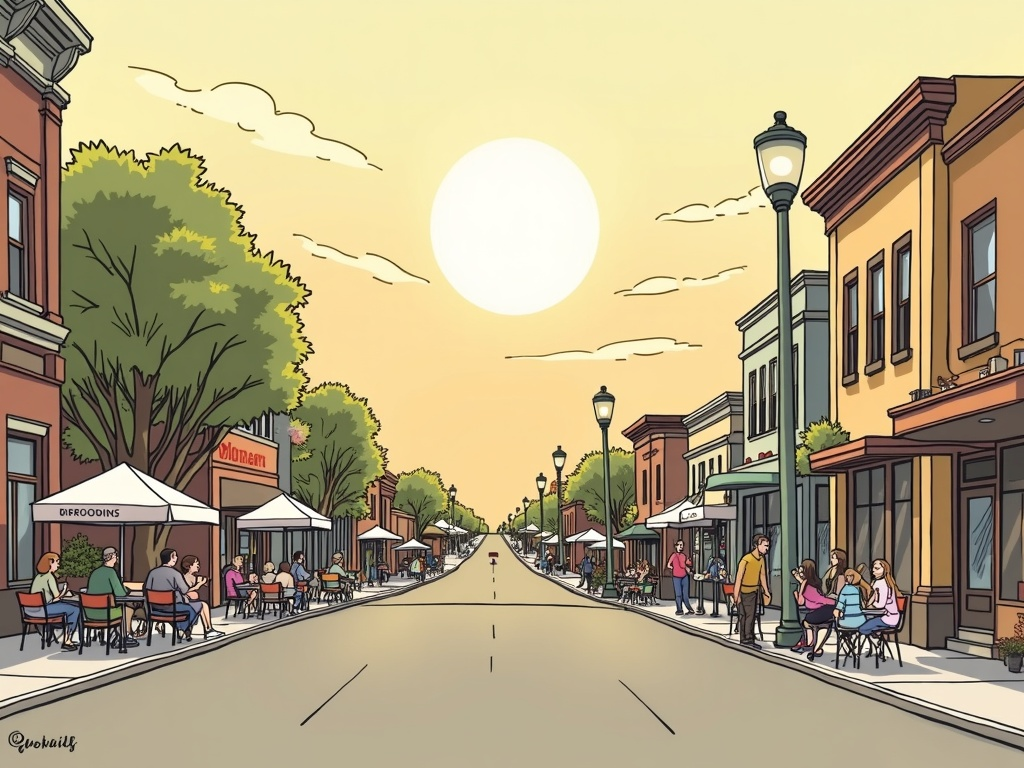
Downtown at Sundown is about as far from a smoke-filled room as a public gathering can get. It is food trucks and folding chairs, kids with balloon animals, a band on a temporary stage. And yet, because at least four of Brookings' council members might plausibly be standing within earshot of each other at the same street festival, the law technically applies. So the city does the responsible, slightly absurd thing: it tells the public, in advance and in writing, that yes, you may see a majority of your council members enjoying kettle corn together, and no, this does not constitute a meeting.
There is something almost comic about the excess here. A different city, a bigger one, would never bother. In a city of a few hundred thousand, the odds of four council members ending up at the same summer concert are low enough not to worry about, and even if it happened, nobody would think to ask. Brookings is small enough that the coincidence is not just possible but expected, week after week, all summer. The notice is not overcaution so much as an honest description of scale: this is a town where the people who govern it and the people they govern share the same six blocks of downtown on a Thursday night.
That proximity is usually described, correctly, as one of the advantages of small-town life. It's also the thing that makes the mechanics of accountability slightly more delicate here than in a state capital. When power and the public share a physical footprint this small, the safeguards meant to keep them separate start to look, on paper, almost fussy. A five-week string of nearly identical disclaimers can read like institutional throat-clearing. But the alternative, a city that simply stopped noticing when its council might gather in public, would be a quieter kind of failure. The value of the notice isn't in what it prevents (nothing was going to happen at Downtown at Sundown regardless) but in what it keeps alive as a habit: the assumption that residents are owed a heads-up any time the appearance of collective power shows up in a public space, even a folksy one.
There's a second, less legal reading available too. The quorum notice is really a map of where the town's elected officials will be standing on a given Thursday. In a media environment saturated with meetings that happen behind screens and packets nobody reads, Downtown at Sundown offers the opposite: a fully public, fully informal encounter with the people who set the budget, argue about zoning, and vote on the things that shape Main Avenue itself. The law's job is to make sure that encounter doesn't quietly turn into governing. What it doesn't regulate, and what residents are free to do with it, is what happens if someone walks up to a council member between the food truck line and the band and says something about the crosswalk on 22nd Avenue.
The notice guarantees the evening is legally empty of business. It doesn't have to be empty of consequence. That part is still up to whoever shows up.