Brookings: The Physics Hiding Inside a Library Ghost
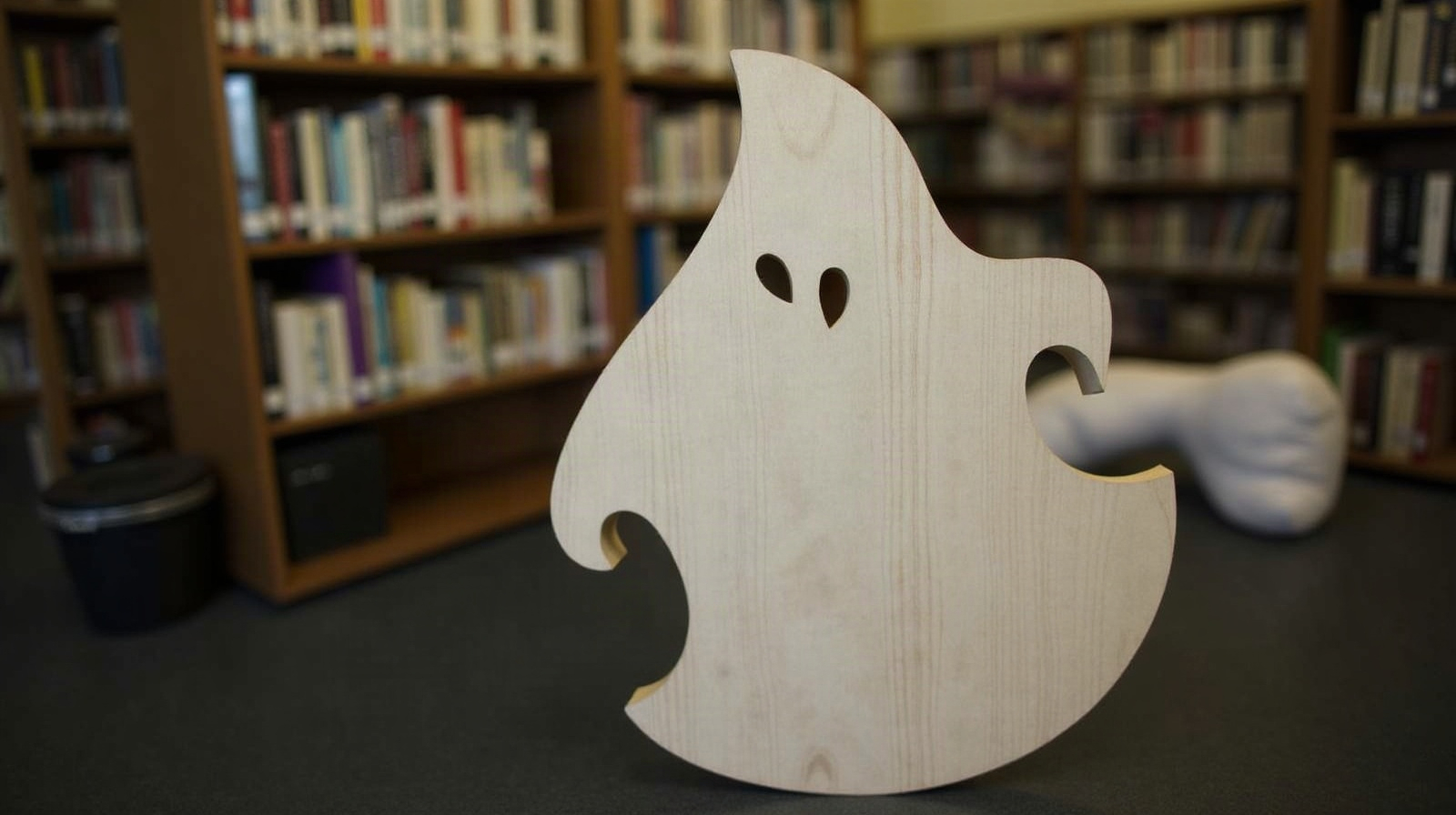
Somewhere between story hour and the periodicals section, the Brookings Public Library owns a machine that can turn a flat sheet of plywood into a ghost shaped like a book or a pumpkin, cut clean enough to paint and hang on a porch. This fall the library is running two workshops built around it: the Wood Ghost Workshop and, a few weeks later, an Acorn House Workshop for a five-inch fall decoration. Both use the library's laser cutter, and both are a good excuse to ask a question that's easy to skip past: how does a beam of light cut wood?
Start with something more familiar. Most kids have, at some point, aimed a magnifying glass at a leaf on a hot day and watched a thin curl of smoke rise where the sunlight concentrated into a bright dot. That's the whole principle, just wildly upgraded. A laser cutter takes light, usually infrared light invisible to human eyes, and focuses it into a spot smaller than a pencil tip. The kind of laser used in most hobby and library machines is called a CO2 laser, named for the gas mixture that produces the beam, and it puts out light at a wavelength of about 10.6 micrometers. Wood, cardboard, and paper absorb that particular wavelength eagerly, converting the light into heat almost instantly at the surface.
The difference between a magnifying glass and a laser cutter is control. A computer, not a wobbly hand, steers the beam along the exact outline of a ghost or an acorn house, tracing a digital drawing point by point at a programmed speed. Where the beam lingers, the wood gets hot enough to vaporize or burn away in a fraction of a second. Where it's told to move fast and light, it barely scorches the surface, which is how a laser can etch a shallow design instead of cutting all the way through. Power and speed are the two dials that matter: more power or a slower pass burns deeper, less power or a faster pass barely marks the surface. That's why the same machine can carve a delicate acorn cap texture and slice clean through a quarter inch of plywood, just by adjusting those settings between passes.
There's a quirk worth knowing if you've ever wondered why laser-cut pieces fit together so precisely. The beam doesn't vanish to a mathematical point, it has a small but real width, and burning material always removes a little more than the beam's exact path, an effect called kerf. If the software didn't account for that, an acorn house's roof piece would end up slightly too small for its base. Cutting software compensates automatically, nudging the cut path outward or inward by a fraction of a millimeter so the finished pieces click together instead of leaving gaps or jams. It's a small, invisible correction, but it's the reason a 13-year-old at the library can assemble a laser-cut kit without a rubber mallet.
It's worth contrasting this with the library's other fall offering, the Cricut Certification Workshop running October 8 and 9. A Cricut cuts with an actual blade, a tiny mechanical edge dragged across paper or vinyl by motors, the same basic idea as scissors guided by a computer instead of a hand. It's shear force, not heat, doing the work, which is why a Cricut handles thin, flexible material beautifully but won't touch a sheet of plywood. Put the two machines side by side and you've got a compact demonstration of two entirely different physical principles, thermal ablation versus mechanical shearing, both aimed at the same goal of turning a digital shape into a physical object.
None of this requires an engineering degree to appreciate, which might be the actual point of a public library keeping this kind of equipment on hand. A ghost shaped like a pumpkin is a fun thing to paint in October. It's also, quietly, a lesson in how light becomes heat becomes a precisely shaped piece of wood, available to anyone in town willing to sign up and show up.