Brookings Trusts You With the Zoning Code Before It Trusts You With the Cricut
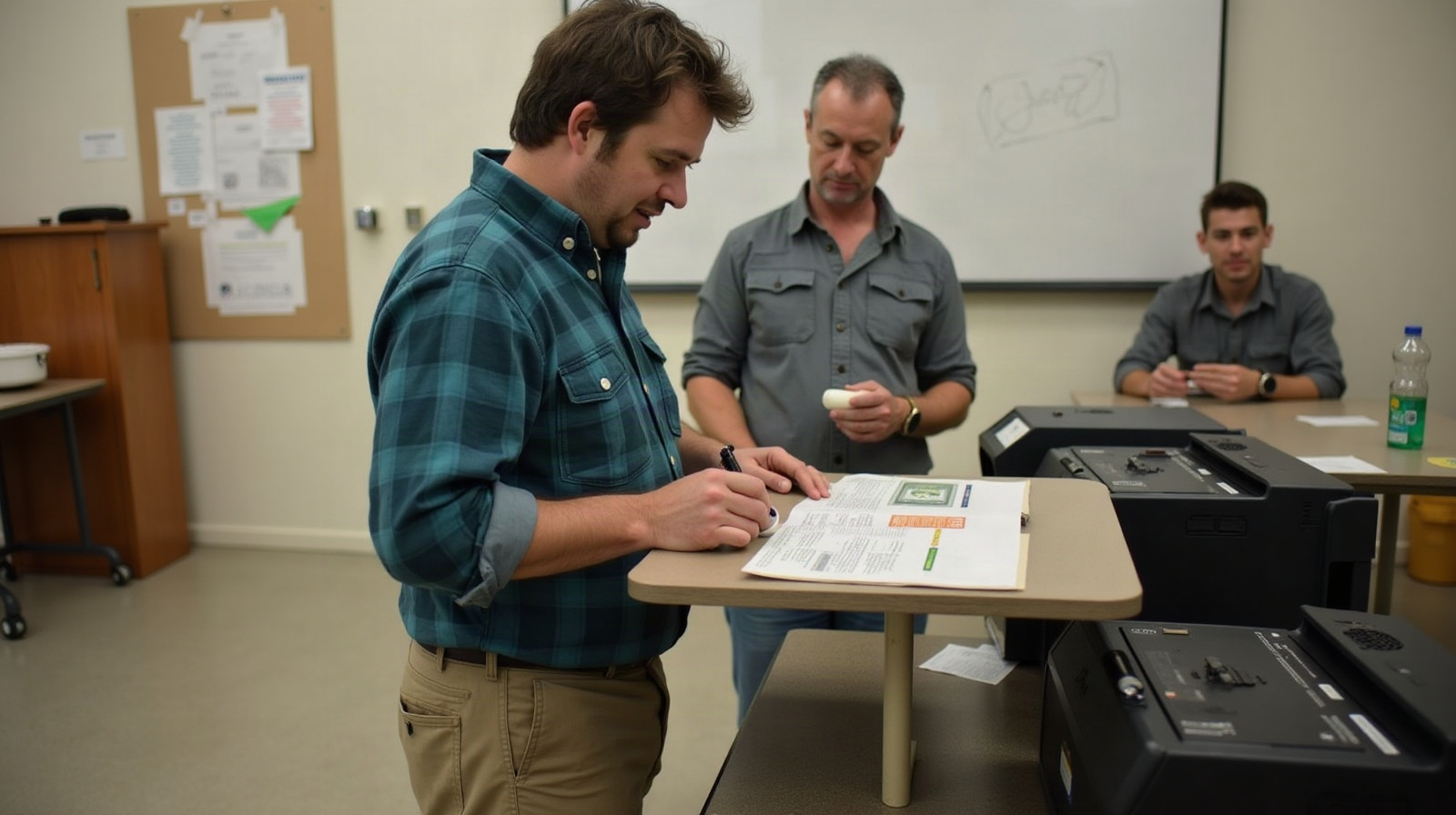
There is a particular kind of civic logic on display this fall in Brookings, and it goes something like this: before you may operate a Cricut Electronic Cutting Machine unsupervised in the library's Maker Lab, you must complete a certification course that runs from 5:30 p.m. one evening clear through 7:30 p.m. the next. That is roughly twenty-six hours of accountability, give or take a night's sleep, for a device whose most catastrophic failure mode is a crooked vinyl decal or a felt letter cut slightly askew.
Meanwhile, across town at the County/City Government Center, a rather different threshold applies. On September 1, the Joint Board of Adjustment will consider a conditional use permit for stables at 1913 20th Avenue, a decision with actual consequences for actual neighbors and actual horses. Anyone wishing to weigh in on that, or on the variance in Bangor Township's “A” Agricultural Land District up for discussion the same night, needs only to sign in before the meeting starts and hold forth for up to five uninterrupted minutes. No orientation. No prerequisite course. No probationary period during which a staff member watches over your shoulder to make sure you don't misuse the blade guard of local governance.
Put plainly: Brookings requires more formal preparation to cut paper than to help decide where horses may legally live.
This is not a complaint, exactly. It is more of an observation about which risks a community chooses to take seriously and which ones it merely files under “open to the public.” The Cricut, after all, belongs to everyone once certification is complete, a genuinely nice arrangement, a little library-shaped commons of blades and cardstock. But there is something almost tender about how carefully that commons is guarded compared to the looser, walk-in-and-speak architecture of public comment at, say, the City Council meeting on August 25, where residents may weigh in by email, by phone, or in person on matters ranging from malt liquor licenses to a preliminary plat for the Legacy Addition, with essentially the same level of vetting required to check out a library book.
Perhaps this asymmetry makes more sense than it first appears. A botched Cricut project is a private failure: a lopsided pumpkin decal, a wasted sheet of adhesive vinyl, no harm beyond the crafter's own pride. A zoning decision, on the other hand, is a public one, and public decisions in a functioning small town are supposed to be made in the open, by whoever shows up, precisely because gatekeeping democracy behind a certification course would defeat its purpose. The five-minute comment period is unsupervised by design. That is the whole idea of it.
Still, it is worth sitting with the picture for a moment: a resident who has never touched a Cricut in her life can walk into Room 310 of the Government Center and speak with total authority on a 765kV transmission line moratorium, no orientation required, while her neighbor down the street is midway through a two-day course just to be trusted alone with scissors that plug into a wall. One of these activities shapes the literal landscape of Brookings County for the next century. The other produces a nice acorn house for the mantel. And yet only one of them comes with training wheels.
Maybe that is simply what small-town governance looks like when it is working: casual about the things that ought to remain open to anyone with an opinion and a spare five minutes, and fussy about the things that could actually hurt someone, even if the someone in question is only a stray finger near a rotary blade. The town, in other words, has sorted its risks correctly, even if the sorting looks a little upside down on paper. Democracy stays loose. Machinery stays supervised. And somewhere in that gap between a public hearing and a certification card sits a small, quietly reassuring truth about what Brookings has decided actually needs protecting.