A Quorum on Main Avenue
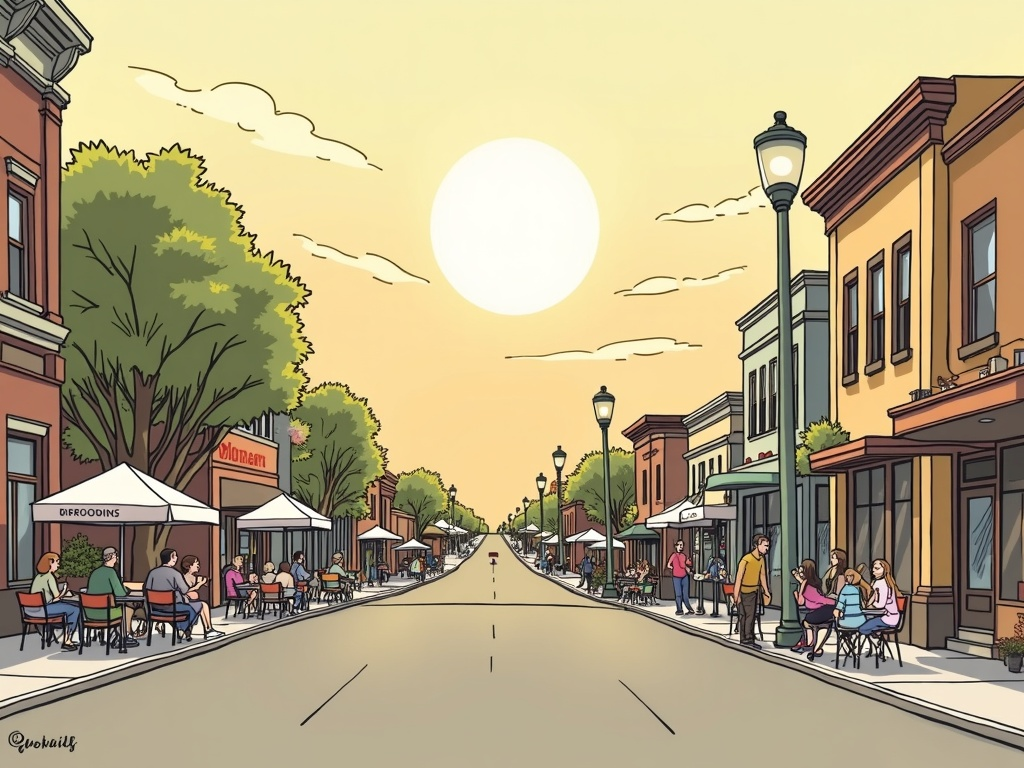
Five times this summer, the city of Brookings has issued nearly the same sentence: Downtown at Sundown runs Thursday evening on Main Avenue, at least four City Council members may attend, and no official business will be conducted. July 30. August 6. August 13. August 20. August 27. The wording barely changes. Read together, the five notices form something unusual: a small bureaucratic liturgy, repeated weekly, announcing in advance that nothing is going to happen.
It would be easy to file this under civic trivia, the kind of item that exists only to be skimmed past on the way to the county road closures. But the repetition itself is worth sitting with, because it says something true and slightly strange about how democracy works in a town the size of Brookings, where the distance between “the government” and “everyone else” is often about the length of a block of Main Avenue on a summer evening.
The notices exist because of open meetings law, the general principle, codified in South Dakota and nearly every other state, that a quorum of an elected body cannot discuss public business outside of a properly noticed meeting. The law was written with a particular image in mind: officials in a back room, a deal struck over coffee, decisions made before the public ever gets a seat at the table. It is a Watergate-era instinct, formalized into statute, meant to prevent power from doing its real work somewhere other than where citizens can watch.
Downtown at Sundown is about as far from a smoke-filled room as a public gathering can get. It is food trucks and folding chairs, kids with balloon animals, a band on a temporary stage. And yet, because at least four of Brookings' council members might plausibly be standing within earshot of each other at the same street festival, the law technically applies. So the city does the responsible, slightly absurd thing: it tells the public, in advance and in writing, that yes, you may see a majority of your council members enjoying kettle corn together, and no, this does not constitute a meeting.
There is something almost comic about the excess here. A different city, a bigger one, would never bother. In a city of a few hundred thousand, the odds of four council members ending up at the same summer concert are low enough not to worry about, and even if it happened, nobody would think to ask. Brookings is small enough that the coincidence is not just possible but expected, week after week, all summer. The notice is not overcaution so much as an honest description of scale: this is a town where the people who govern it and the people they govern share the same six blocks of downtown on a Thursday night.
That proximity is usually described, correctly, as one of the advantages of small-town life. It's also the thing that makes the mechanics of accountability slightly more delicate here than in a state capital. When power and the public share a physical footprint this small, the safeguards meant to keep them separate start to look, on paper, almost fussy. A five-week string of nearly identical disclaimers can read like institutional throat-clearing. But the alternative, a city that simply stopped noticing when its council might gather in public, would be a quieter kind of failure. The value of the notice isn't in what it prevents (nothing was going to happen at Downtown at Sundown regardless) but in what it keeps alive as a habit: the assumption that residents are owed a heads-up any time the appearance of collective power shows up in a public space, even a folksy one.
There's a second, less legal reading available too. The quorum notice is really a map of where the town's elected officials will be standing on a given Thursday. In a media environment saturated with meetings that happen behind screens and packets nobody reads, Downtown at Sundown offers the opposite: a fully public, fully informal encounter with the people who set the budget, argue about zoning, and vote on the things that shape Main Avenue itself. The law's job is to make sure that encounter doesn't quietly turn into governing. What it doesn't regulate, and what residents are free to do with it, is what happens if someone walks up to a council member between the food truck line and the band and says something about the crosswalk on 22nd Avenue.
The notice guarantees the evening is legally empty of business. It doesn't have to be empty of consequence. That part is still up to whoever shows up.